

Estimated reading time: 6 minutes
By: Dr. Jamie Long
If the word feedback instantly makes your stomach drop, your nervous system is probably clocking it as dangerous. Here’s why…
For people pleasers, feedback rarely lands as neutral information. It lands as a verdict. A threat. Proof that you messed up, disappointed someone, or are about to lose connection. So you apologize too fast, over-explain, shut down, or agree to things that don’t feel true just to make the discomfort stop.
Here’s what often gets missed: the problem isn’t that feedback is hard—it’s that people pleasing turns feedback into a referendum on your worth.
And nowhere does this show up more clearly than in close relationships.
Why Feedback Is Inevitable in Every Close Relationship
Every close relationship will, at some point, involve feedback.
- A partner tells you something you said hurt them
- A friend shares that you’ve felt distant lately
- A coworker asks you to change how you communicate
These moments matter. How we respond can either strengthen trust or erode it.
Feedback can feel like a gift—or like a punch in the gut. Sometimes it hits a nerve, activates old shame, or tempts us to either shut down or go on the defensive. But in healthy relationships, feedback isn’t an attack. It’s information.
Learning how to give and receive feedback skillfully is one of the clearest markers of emotional maturity. And yet, people pleasers are rarely taught how to do this well. They’re taught something else entirely.
The Bad Advice That Keeps People Pleasers Stuck
Most people pleasers were taught some version of:
- “Just be open to feedback.”
- “Don’t take things personally.”
- “Stay humble.”
- “If someone’s upset, you should listen.”
On the surface, this sounds healthy. In practice, it often leads to self-erasure.
People pleasers don’t just consider feedback—they absorb it as an absolute truth. They assume the other person must be right. They override their own perspective. They apologize reflexively, even when the feedback is incomplete, exaggerated, or flat-out inaccurate.
This isn’t emotional maturity. It’s a survival strategy.
People Pleasing Turns Feedback Into a Shame Spiral
When you struggle with people pleasing, feedback doesn’t feel like data—it feels like danger.
Instead of asking:
“Is there something useful here?”
Your nervous system asks:
“Am I bad?”
Because once feedback becomes about your worth, your response is no longer grounded. You’re either:
- Over-accommodating to make the discomfort stop
- Defending yourself to protect your image
- Collapsing into shame or emotional overwhelm
None of these build real intimacy.
The Four Styles of Responding to Feedback
To make this pattern easier to recognize, we teach feedback using a visual matrix that maps responses along two dimensions:
- Do you integrate or reject the feedback?
- Do you stay grounded in self-respect or fall into shame?
This creates four common styles of responding to feedback.
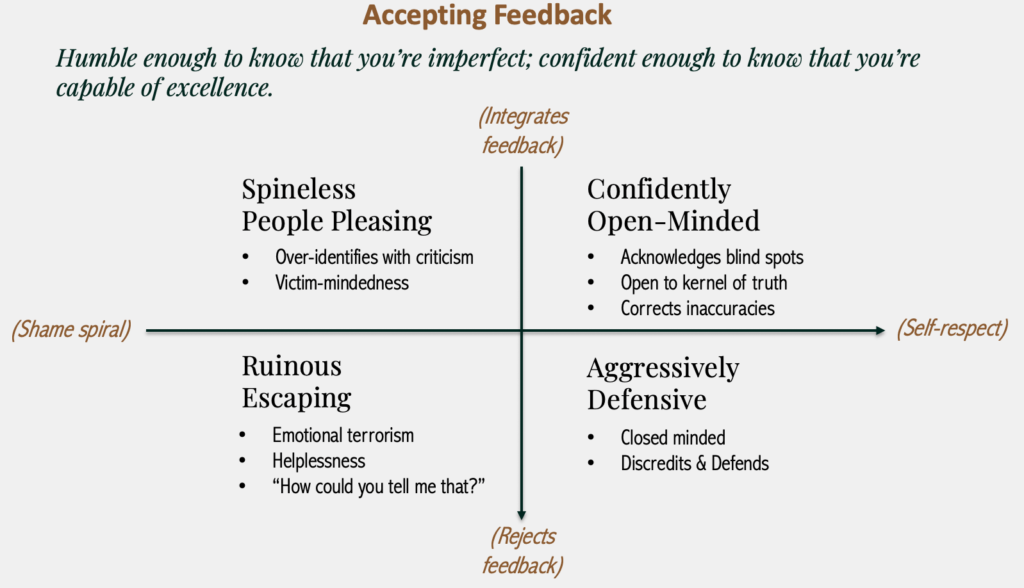
🟩 Confidently Open-Minded (Integrates Feedback + Self-Respect)
The healthiest response zone
- Acknowledges possible blind spots
- Looks for a “kernel of truth” without over-identifying
- Clarifies or corrects inaccuracies
- Maintains self-respect while staying open
This stance says: “I’m willing to consider this—and I still trust myself.”
🟦 Spineless People Pleasing (Integrates Feedback + Shame Spiral)
- Over-identifies with criticism
- Takes responsibility for everything
- Feels helpless, victimized, or small
- Apologizes reflexively
This response sounds open—but it’s actually rooted in fear and self-abandonment.
🟥 Aggressively Defensive (Rejects Feedback + Self-Respect)
- Closed-minded
- Discredits or attacks the person giving feedback
- Protects image at all costs
- Prioritizes being right over being connected
This stance preserves ego, not intimacy.
🟨 Ruinous Escaping (Rejects Feedback + Shame Spiral)
- Emotional overwhelm
- Guilt-tripping or emotional manipulation
- Helplessness (“How could you tell me that?”)
- Shuts down growth entirely
This response avoids feedback by collapsing under it.
Why People Pleasers Struggle Most With Feedback
People pleasers are often praised for being “open,” “easy to talk to,” or “kind.”
But what’s really happening is this:
They confuse openness with self-blame.
They believe:
- If I don’t accept this feedback fully, I’m defensive
- If someone is hurt, I must be wrong
- If I push back, I’m unsafe or unkind
So instead of developing discernment, they develop compliance.
And over time, that erodes self trust.
What Confidently Open-Minded Actually Looks Like
Being good at feedback does not mean:
- Agreeing immediately
- Apologizing for things you don’t believe
- Ignoring your own experience
It means slowing the moment down.
A confidently open-minded response might sound like:
- “I want to understand what you’re experiencing—can you say more?”
- “There may be part of this that’s true, and there’s also context you’re missing.”
- “I hear your feedback, and I have a different perspective I’d like to share.”
Notice what’s missing: self abandonment.
This stance integrates feedback without sacrificing yourself.
The Real Risk Isn’t Feedback. It’s Avoiding the Skill.
Many people pleasers delay learning how to handle feedback because staying agreeable feels safer than rocking the boat.
But inaction isn’t neutral.
Avoiding this skill is what keeps:
- Resentment building
- Misunderstandings unresolved
- Relationships feeling fragile
The longer feedback feels threatening, the more power it has over you.
Integrating Feedback Is a Skill
People weren’t born “good at feedback.” They were taught.
They learned how to:
- Stay grounded when uncomfortable
- Separate information from identity
- Hold their boundaries and their openness
It’s skill that can be learned.
Want Help Breaking the People-Pleasing Pattern?
If people pleasing has been shaping how you respond to feedback, you don’t need to become harsher or more defensive. You need better emotional skills.
Our course EQ101 teaches evidence-based tools from CBT, DBT, ACT, and mindfulness to help you:
- Respond to feedback without spiraling
- Set boundaries without guilt
- Stay open without self-abandoning
- Build relationships that feel secure—not fragile
Whenever you’re ready, you can unlock access to EQ101 and start practicing these skills in real life.
You can also download our free companion handout—18 Universal Rights—to ground yourself in what you are (and aren’t) responsible for when feedback comes up (below).
Growth doesn’t come from being nicer. It comes from being more grounded.


Dr. Jamie Long is a licensed clinical psychologist in Fort Lauderdale and owner of The Psychology Group. She specializes in anxiety, depression, eating disorders, and helping people through general life changes.
Call or text (954) 488-2933 or email today to discuss how our psychologists can help you.